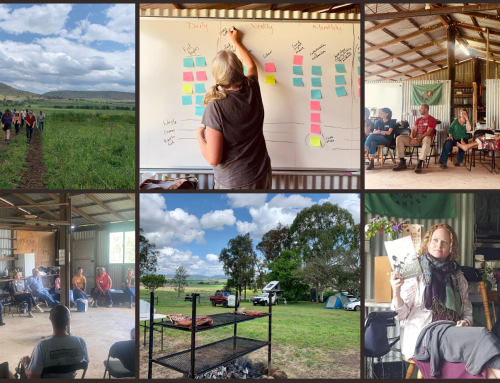
This year, once again, from 10-12 October 2026, we gathered with joy and commitment on djandak, the unceded lands of Djaara, for AFSA’s annual Food Sovereignty Convergence. And what a gathering it was. We heard first-hand from farmers, First Peoples, workers, labour organisers, researchers and other allied organisations about their struggles and a pluriverse of initiatives.
As the world rapidly changes, people globally are rising against fascism and injustice while fighting for their own future. In this context, AFSA members and aligned organisations came together to build solidarity, share current struggles and priorities, and, most importantly, discuss how we can collectively work toward a world beyond capitalism, patriarchy, and colonialism.
We began by listening to Gellung Warl elected Co-Chair Djaran Murray-Jackson talk about Treaty, and AFSA’s Focal Point for Farmers Tammi Jonas shared the history of the international food sovereignty movement and AFSA’s involvement in it here and globally. We heard from Australian Manufacturing Workers Union, Earthworker Cooperative, Degrowth Network, AI Safety Symposium, Pesticide Action Australia, Namanbunda Farm, Guerilla Gardening Naarm, Merri-bek Tech, Yarra Valley Water, Food Connect Foundation, Organic Regenerative Investment Cooperative, Otway Agroforestry Network, FILEF (Federation of Italian Migrants Workers and their Families), Holding Ground, and many other farmers, researchers and individuals, coming together to imagine and enact better ways of living on Country. 
We recognise that beyond ideologies, class, gender, sexual orientation, ethnicity, age, nationality or religion, we share a common goal. Our movement must be intersectional, uniting farmers, First Peoples, workers, and advocates facing connected struggles. Solidarity requires respecting diverse struggles to shift power for structural change, while using reform to enable deeper transformation.
We reject the ‘There Is No Alternative (TINA)’ discourse and the pragmatism that drives it. We reject the false choice between individual survival and collective transformation. We choose solidarity over isolation, and shared power over corporate control. In fact, we believe there is an alternative, one that our movement is actively creating, defending, and trying to make everybody’s normal.
We are building a new/old model that renders the existing one obsolete. When we care, show up and bring people, materials and labour together for the common good, rather than prioritising individual interests, we can create the world we want to live in. Dismantling capitalist structures remains impossible without confronting patriarchy, just as challenging systemic racism demands the total unravelling of settler colonialism. True liberation cannot be realised for any of us until it is achieved for all. ‘You look after land in action, and it builds empathy, so people become more connected. Old people … they knew the law of relations, looking after land, looking after kin, looking after people’ (Graham 2017).
Our historical context, First Peoples’ sovereignty and Treaty
 In 1996, La Via Campesina (LVC) introduced food sovereignty to challenge corporate-led, market-driven global agriculture and offer a paradigm to fight hunger by strengthening local economies. Food sovereignty is the right of peoples to healthy, culturally appropriate food produced and distributed in ethical, ecologically sound, and socially just ways, and our right to define our own food and agriculture systems. In this context, AFSA has led the fight for food sovereignty and agroecology in so-called Australia since 2013, and is a proud member of La Via Campesina and the International Planning Committee for Food Sovereignty (IPC). Following the 3rd Nyéléni Global Forum in 2025, the movement set a Common Political Action Agenda (CPAA) across five axes used at this year’s Convergence: mobilisation, policy advocacy, movement building, political formation and storytelling.
As Custodians feeding communities across generations, Indigenous Peoples are central to this struggle. As AFSA’s First Peoples First strategy notes:
“Agroecology fundamentally aims to promote the deep ecological, social, and economic knowledge of First Peoples, peasants, and other small-scale food producers and custodians of Land. It puts decision-making power back in the hands of Indigenous Peoples and peasants and local communities.”

To begin, Djaran Murray-Jackson shared his journey in the food system, from working in a supermarket produce department to becoming a butcher by trade, and now serving as Co-chair of Gellung Warl and Reserved Seat holder representing Dja Dja Wurrung Clans Aboriginal Corporation. He reminded us that food is about relationships with Land and people, and that Treaty offers a framework for power, partnership and collective self-governance. Established as a legally binding agreement between Victoria and First Peoples, Treaty includes three arms: the First Peoples’ Assembly; an oversight body (Nginma Ngainga Waraan); and a truth-telling office (Nyerna Yoorrook Telkuna). Inspirational and exciting, his speech opened up the doors for our movement to build ongoing relationships with Treaty. Read his full speech here.
AFSA aligns with First Peoples’ priorities, committing to build relationships with and support Gellung Warl, support self-determination, and embed Yoorrook Justice Commission recommendations in policy and advocacy.
Unconference methodology
 After we heard key priorities from each allied organisation during the opening plenary, we broke out into three groups: technology sovereignty, collective infrastructure, and pesticides. Using an adapted version of the ‘world café’ methodology, where everyone except the facilitators engages with all topics, we had very exciting conversations across the 5 axes of the Nyéléni CPAA (mobilisation, policy advocacy, movement building, political formation and storytelling) and cross-cutting themes such as First Peoples, labour, climate, geopolitical conflict, women, youth and water.
Technology sovereignty
The global AI boom is driven by corporate interests and government enthusiasm for investment and fear of being left behind, while communities absorb the costs: pressure on energy, water, land, food systems and democratic decision-making. Alternatives to the ‘get big or get out’ paradigm exist, and we need to change the narrative and mobilise against this damaging model that concentrates wealth and control in the hands of a few technology corporations while accelerating climate change.
Contrary to what you will read in the mainstream media, mass mobilisations by local communities are delaying or even cancelling some data centre permits here and globally, and this struggle has the potential to galvanise a much broader movement. There is an unmistakable opportunity to join forces with other movements as concern grows across both regional and urban communities, particularly where data centre proposals threaten agricultural land, green wedges and the liveability of affected neighbourhoods. (AFSA’s submission on AI / data centres)
 Collective infrastructure
By collectivising infrastructure, we create shared structures that build collective power, redistribute resources and challenge corporate control. However, this necessitates a long term commitment to systemic change. The Agroecology Land Trust or Meat collectives are exciting and emerging examples that prove political formation is key to ensure the work is not driven only by individual projects or personal aspirations, but by a shared commitment to collective struggle, mutual responsibility and long-term change. People joining these projects will need to understand AFSA’s economic principles and undertake political and agroecological formation before starting their land stewardship and collectivising work.
Pesticides campaign
 Following up on the Pesticide Action Australia Residue Report, which blows the lid on the over-use and even illegal use and presence of chemicals in fruit and veg found in Coles and Woolies, we discussed how to use the campaign’s data to strengthen policy advocacy and expose the wider connections between pesticide use and the corporate control of the food and education systems.
Corporate influence over agricultural education is significant, including university agronomy courses, agricultural extension programs and research agendas. The corporate industrial model promotes an obsession with producing more, at lower cost and primarily for export, often at the expense of soil health, water, biodiversity, farm workers and community health. These connections led us to decide to develop a campaign targeting educational institutions, beginning with teachers, researchers and universities, and challenging the harm caused in the pursuit of profit maximisation. To avoid focusing on false solutions, we advocate for agroecology as a proven practical and political way out of this system.
It is no secret that one thread ties all these themes together: corporate concentration and control of food and agriculture systems, from the land to what choice any of us have to eat. If they are losing a profitable model to keep extracting ingredients for ultra-processed foods (UPF) from chemical-laden monocultures, they will farm our data on those same degraded lands, while also controlling the diminishing number of abattoirs, dairy processors, grain mills, and markets. But our movements are showing that we can take back control of land, labour, and the health and fabric of our communities. Every parcel of land put into the Agroecology Land Trust is removed from the speculative market and brought back into the commons, prioritising First Peoples’ sovereignty and self-determination, bringing us back into mutual obligations with land and each other as Country asks of us. Every micro-abattoir and community grain mill supports a community of local peasants and the people we feed in a resilient and healthy food system while combating climate change. And every skill we reclaim to look after the land and each other, to reclaim processing, repairing, communicating and more, is a mud brick in the new house we are building together.
¡Viva La Vía Campesina!
We drafted a spreadsheet with all actions decided at Convergence, if you’d like to get involved, please reach out at coordinator@afsa.org.au and we’ll share the link!